
#481 – Cut/daily Meets... Editor Billy Fox
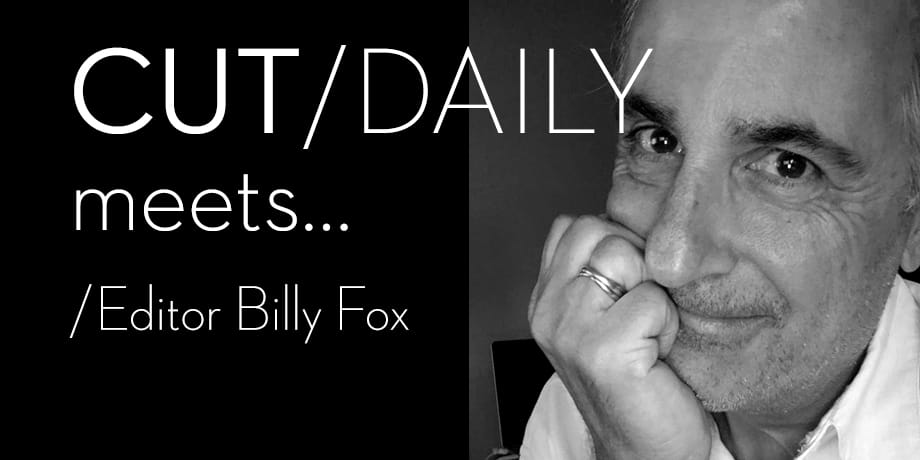
Editor Billy Fox has a fascinating resume.
He's edited over 60 episodes of popular TV series, while being nominated for 7 Prime Time Emmy's for his work on Law & Order and the seminal, Band of Brothers.
He lept into feature film editing racking up credits such as:
- Hustle & Flow
- Four Brothers
- Black Snake Moan
- Straight Outta Compton
- Only the Brave
- Dolemite is My Name
Song Sung Blue is his latest collaboration with director Craig Brewer, having worked together ever since Hustle & Flow, 20 years previously.
As a result, I hope you enjoy the bonus questions I put to Billy too!
Editors are often pegged for a specific kind of show or material, yet you've cut a lot of different things (picking some of my favourites) – Band of Brothers, Black Snake Moan, Dolemite Is My Name – plus a wide variety of TV series.
Why/how have you been able to edit so many different kinds of projects?
For me, selecting a project is an exercise in alignment.
I look for scripts where I feel an immediate personal connection and where my two primary passions—compelling drama and strong musical themes—intersect.
This specific blend is what draws me to Craig Brewer’s work; his films are built on a musical foundation without sacrificing narrative depth.
The most important takeaway is clarity of purpose.
You have to ask yourself if the project is something you genuinely desire, rather than simply an opportunity for a paycheck.
Find the thematic through-line that resonates with you—whatever the genre—and dedicate yourself to evolving your technique within that space.
Song Sung Blue is your (by my count) 6th collaboration with director Craig Brewer.
What do you think the secret to long-standing editor/director relationships is, and how did that evolve over time for you guys?
One of the most critical aspects I look for is a genuine connection with the director or writer-director. True creative alignment is often only revealed once you are in the trenches, but when it works, it is telepathic.
The ideal scenario happens in the editing room: We are watching a cut, and I notice a nuance on screen. Without a word, I feel the director’s head turn toward me. I just look back and say, “Yeah, I saw that too.” The note never even needs to be discussed; we are simply thinking the same thoughts.
Conversely, discovering you lack that commonality is a challenge.
If your sensibilities differ, you have to contort your own instincts to match the director's vision. That’s why striving for that initial alignment is so important.
With Craig, I was lucky in that we were in sync from our very first project Hustle & Flow. His scripts are so strong in their storytelling, and his sense of timing—what’s needed to move the story forward and what isn’t, how the music drives the rhythm of the scenes—all line up with my own instincts.
That connection has just continued to evolve on each subsequent project.
NSFW language in this trailer...
Song Sung Blue looks like it hits a lot of different notes (excuse the pun) emotionally.
How do you calibrate each scene to be as sad/funny/moving/heart-warming/entertaining as possible while still smoothly moving through the overall emotional arc of the story?
It's basically the same process whether I'm cutting a single scene, a series of scenes, an act, or the arc of the entire movie.
The whole process is based upon looking for the heartbeat—looking for the rhythm of the natural flow of whatever that scene is supposed to be for the story.
So it can be a heartwarming scene, a funny scene, a sad scene, an intense or exciting scene, but connecting them all together is basically the rhythm of a heartbeat that runs as you watch the film. You can feel that it's running too fast or too slow.
You're constantly modulating the rhythm so that it fits whatever the emotional purpose of the scene—or that part of the movie—is supposed to be, to tell the story.
Often times when a scene is not working right, the problem is so subtle that it's literally a couple of frames’ movement, and the rhythm falls back into place. So any time I'm cutting, regardless of what it is, it’s basically looking for the heartbeat, and then maintaining that heartbeat as I make more and more changes.
When we go through the director’s cut, we’re developing and amplifying that heartbeat.
And then, more challengingly, as we go through the producer's cut or studio cut, it’s working within the hard realities of time and money to maintain (and sometimes defend) that heartbeat you worked so hard to create.