
#503 - FrameRate feels like home
It's funny when a place feels like home.
It's sort of indefinable yet undeniable.
That's the feeling I get when I'm on FrameRate.
But we're jumping ahead of ourselves.
Let's back up.
In late 2025 Vimeo was sold for $1.38 billion in cash to BendingSpoons, a European mobile app developer with a notorious reputation for buying up beloved (yet often in decline) internet brands (WeTransfer, Evernote) and then (usually) driving up prices, cutting costs, slashing features and generally annoying the entrenched user base.
So when motion graphics artist and serial entrepreneur Tyler Williams read those headlines, he saw an opportunity to build a better home for the growing diaspora of editors, animators, VFX artists and filmmakers leaving Vimeo in their droves.
This is the origin story of FrameRate.
Which, while it's only just getting started, has already resonated with a global community of artists enticing some big name creatives to move in and generating enough online buzz that even my own brother was trying to hook me up with an early invitation.
Doesn't he realise I know people...
So what?
So as a working video editor you need somewhere to
- showcase your work
- host your video embeds
- help you land new gigs
- expand your creative horizons
Vimeo is dying, YouTube won't cut it.
FrameRate is it.
Vimeo is dead. Long live FrameRate.
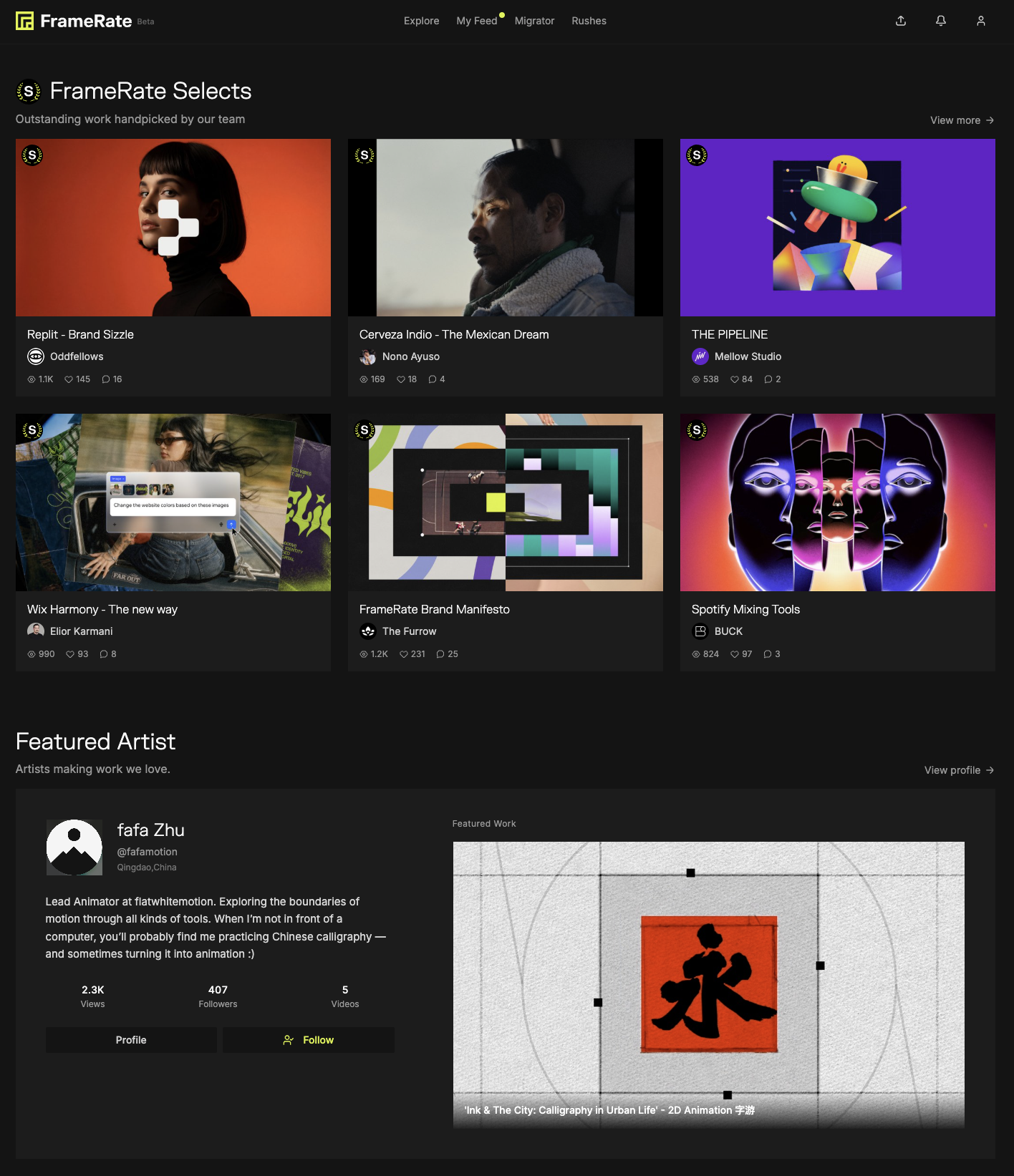
This week Cut/daily is partnering with FrameRate to bring you the inside story of the creation of everyone's new favourite place to showcase their work, get discovered and dance in the stream of creative inspiration.
So what is FrameRate?
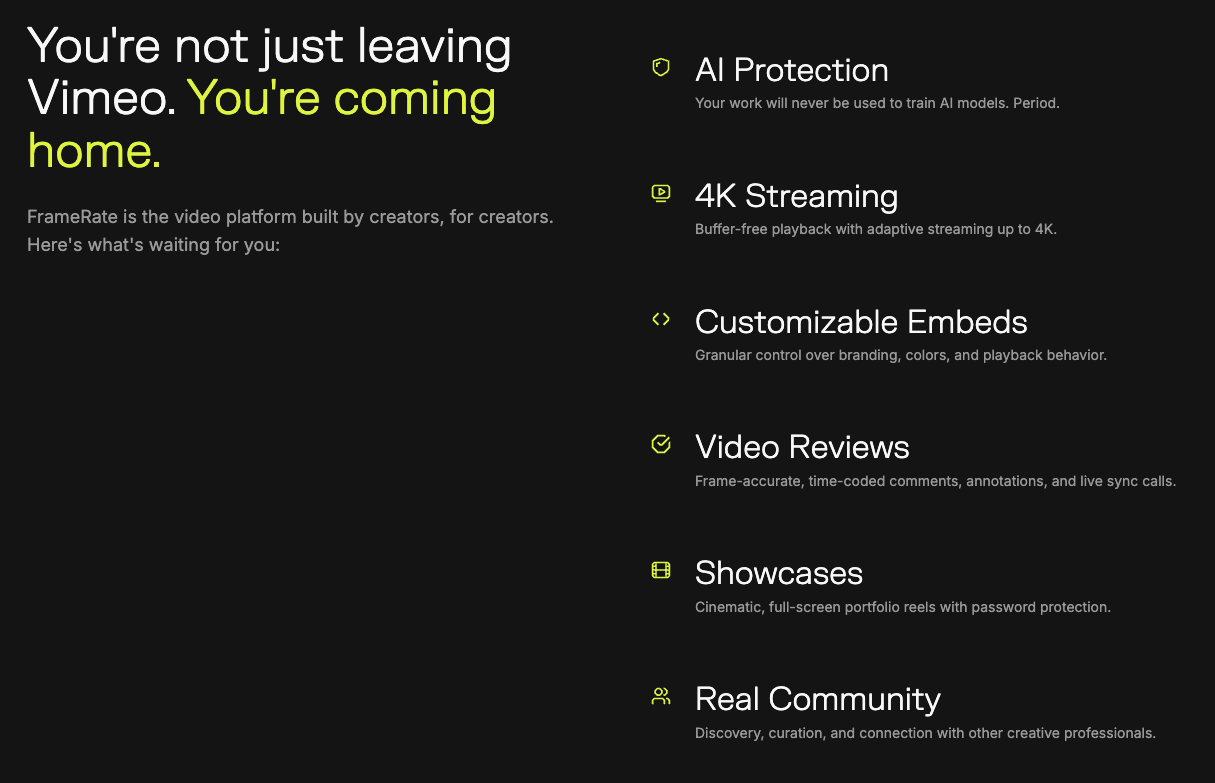
It's the new Vimeo that's like the old Vimeo you used to know and love - where a Staff Pick actually meant something, where filmmaking careers could be launched and where you didn't mind sending clients to check out your previous work – but better.
What does FrameRate do?
- Customisable video hosting
- Feedback review links
- Synchronised live playback
- Showcases
- Collections
- Available for work banners
- Video analytics
- Community messaging and much more
How much does it cost?
A $10 a month Plus plan gets you 2.5TB of storage with 4K video hosting and videos up to 50GB in size.
The $20/month Pro plan doubles that and includes premium encoding quality (although the encoding on the Plus plan is already great!)
to get 15% (up to $54!) off the first 12 months of any plan.
Is this really different?
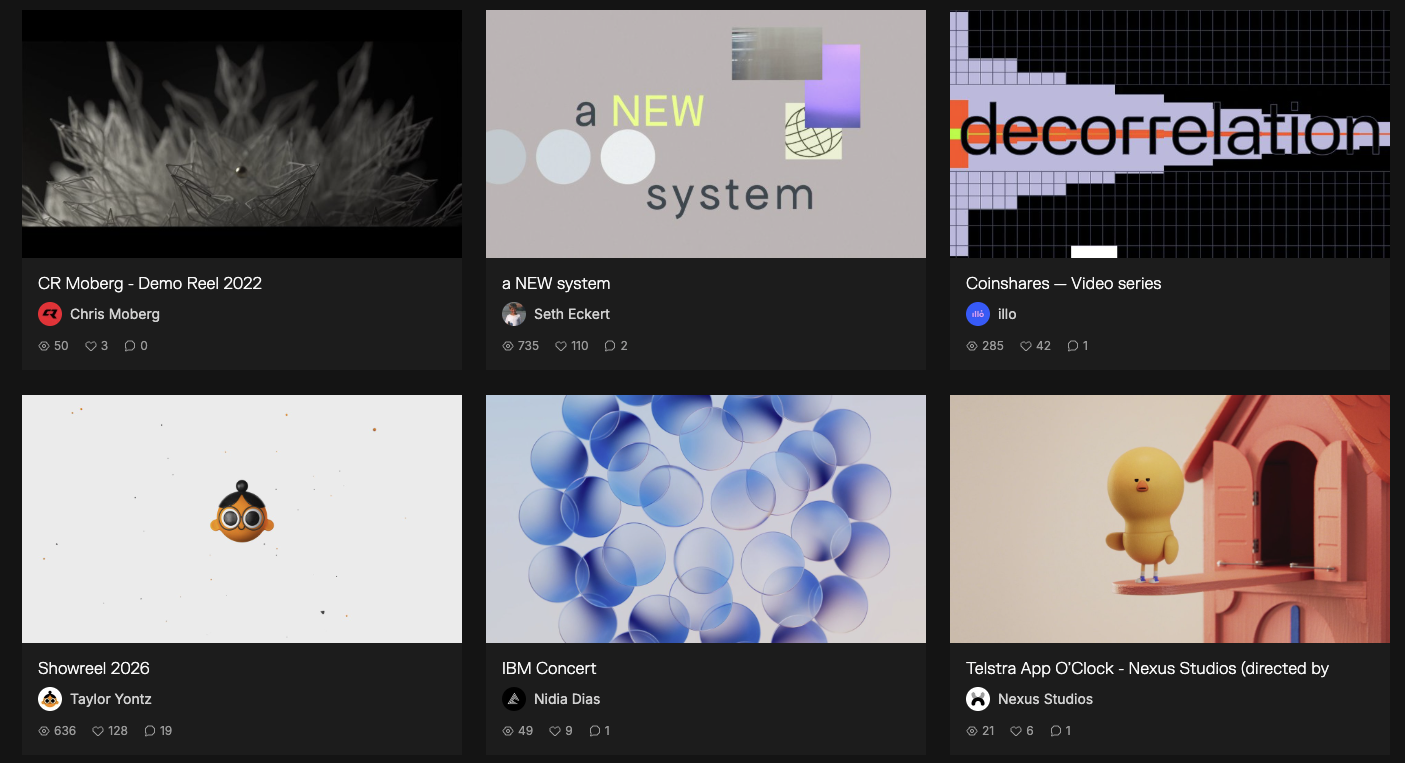
Yes. Genuinely.
FrameRate founder Tyler Williams originally built Motion Array for a decade before he, and co-founder Eri Levin, sold it to Artlist.io in 2021.
That was an artist first community which thrived on the strength of the work in the marketplace and the profit sharing with those creators.
Similarly FrameRates's goal is to put the work front and centre, along side the artist that created it and to help those artists succeed by getting noticed, and paid for their talents.
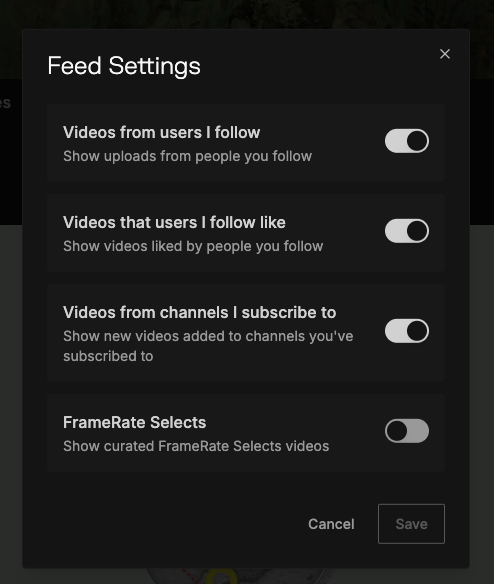
Another aspect of FrameRate's design approach that I appreciated is the ability to customise what content is shown to you in the 'Feed' section, so that you're not at the mercy of an untouchable algorithm for the kind of new content you can discover.
The goal isn't to keep you doom scrolling into brain rot.
How do I move in?
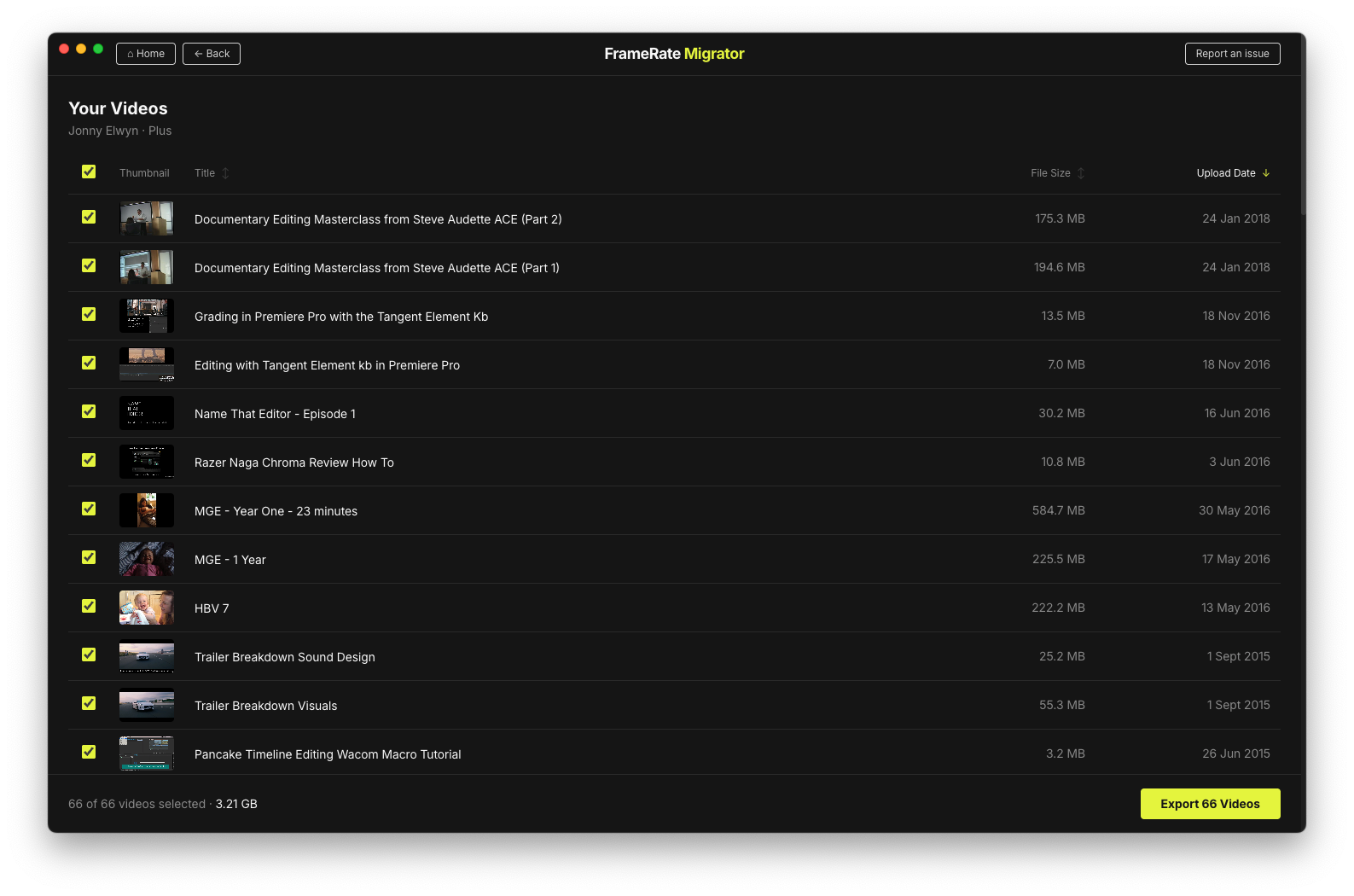
If you're looking to leave Vimeo and set up shop on FrameRate, they've built a handy migrator tool that (once you grant it access) will automatically download your entire Vimeo library, backing those files up to a local drive and then upload them into FrameRate for you.
Only takes a few minutes on a fast connection (depending on your library of course!) and I was glad to have a complete local back up of all my old work.
Check out my FrameRate profile here.
Is it perfect?
Not yet - but it's early days for a small team of two, so expect a lot of incremental improvements to the current user interface and user experience, plus a lot of cool new features coming along in good time.
One of the recent additions to the team is a freelance designer who is bringing some cohesion to the whole platform, which will no doubt streamline and enhance a few corners where things feel a little ‘beta’.
For example, while it was great that everything the migrator tool brought over from Vimeo was saved as a draft by default (rather than public), it was time-consuming to update these as there is no way to batch change the draft/public/private/hidden toggle for a group of videos.
Or that the main profile menu has links to 14 different pages, which is a little overwhelming.
But when it comes to hosting your work, showing it off and feeling proud to showcase what you've created – there FrameRate sings.
Use the exclusive discount code: CUTDAILY to get 15% off your first 12 month plan on FrameRate.
Interview with FrameRate Founder Tyler Williams

When did you decide to build FrameRate?
I'd been building all these different things that I'd wanted to work on over the years, and I think at the end of the day I just lost enthusiasm for them because they felt like I was forcing myself to work on something that didn't excite me — search and advertising, that kind of thing.
And then I took a break for like six months and just quit everything. And then, when I was least expecting inspiration to strike, I saw the Bending Spoons acquisition.
I had watched Vimeo slowly die over the years, and it's such a big part of my early days as a motion designer — staff picks, starting my day on Vimeo, checking out what's new, and ending my day on Vimeo, seeing what had been uploaded throughout the day.
That had always been in the back of my mind, that missing of Vimeo. But when Bending Spoons bought them, that definitely put things in motion.
How quickly did you have something that made you think, "Yeah, this is going to work"?
With the assistance of AI, I probably had something — like a very basic MVP — in a week. Where you could upload videos and browse and do that kind of thing.
And then I sent it to Joey Korenman of School of Motion, and he was like, “Wow, this is awesome.” And he gave me the motivation I needed to keep going with it.
He then introduced me to Justin Cone from Motionographer, who was very complimentary of what I was doing and seemed interested in being involved somehow.
So we figured that out together and Joey has been instrumental in sharing what we're doing and getting early users for us. We owe a lot to him.
What's the split between you and Justin in terms of responsibilities?
We're both in it full-time. It's so funny — early stage with two people, we're kind of doing everything. But I'm primarily responsible for the product, and he is primarily responsible for building the community and getting the word out. So almost like product and marketing, but not marketing in a traditional sense.
The response seems to have been overwhelmingly positive — people raving about it on LinkedIn, sharing it around. Has it surprised you?
Yeah, the response has been overwhelmingly positive, and I get messages every day through FrameRate from people thanking me for building it, which is super motivating.
But at the same time, I take a lot of pressure from that to build something great for everyone.
There are some naysayers, of course. But it's interesting because I think a lot of those people who talk slightly negatively about it are more of a younger generation that are used to uploading something to Instagram and getting a thousand likes instantly. And I'm just like — what monetary value do those likes actually have? What does that actually mean?
And of course, they also want free hosting. It's just a different generation, I think. And they mentioned they wouldn't mind advertising on the site, and I'm like, no.
To me FrameRate feels like the old internet — the one worth being excited about. Was that always the guiding principle?
Yeah, from the very onset, the idea was to put the work and the artists front and centre, and try to have the site take a back seat as much as possible.
With your background as a motion designer, how have you harnessed that eye for detail into building the site? Are there particular things you're proud of?
I just see where all the improvements need to be made at this point!
That's why I brought on a professional designer to really think more thoroughly about the process. Because at first I was taking my time with the design. But then as people started using it and we started getting feedback and we needed more functionality, I wasn't able to think so thoroughly about the design, and I think unfortunately some of that's kind of found its way in — especially in the account section. But hopefully it'll be cleaned up shortly.
That said, I do like the review tool that we built. I'm sure it can be tightened up, but yeah, pretty proud of that.
In terms of paid accounts, are people signing up?
We're actually making money, which is fun. At first, we gave away a bunch of free accounts because that's kind of the only way to populate it, and then we slowly tapered it off. And now people are joining every day.
Unfortunately, the whole onboarding process and the drip campaigns and all of that — we don't have that right now, just because we're so focused on building the product. I'm sure we're losing some people that way. But I would rather focus on making a great product than worrying about optimising for conversions at this point.
What should video editors know about FrameRate — why should they use it?
Aside from hosting their work — embedding it on their sites, doing client reviews — you can also create showcases, which let you group a bunch of your work to send to a client for a specific genre, say if you're doing food videos and you want to send just that over, for example.
But I think at the end of the day, for it to be successful in my eyes is that people are actually getting work through the platform. And I know it's kind of a chicken-and-egg problem, so we're focused now on building out the community and getting as many great artists on here as possible, so that it will attract people looking to find new talent to work with.
I definitely don't want it to turn into like a freelancer site where we're taking a cut of money. It would be that one hundred percent of the revenue goes to the artists and we wouldn't be taking anything.
You've been very clear that you won't train AI on the content. Are there other principles underpinning the site?
Yeah, mainly it's putting the work front and centre, and making sure the site takes a back seat. We don't train any AI — there are absolutely no plans on doing that — and we'd never sell access to the content to be trained. But, you know, some AI bots are very aggressive. You can only do so much. But the intention is clear.
What's your best-case dream scenario for FrameRate?
That it just becomes the go-to place for anyone working with moving images — for inspiration, to host their work, to get work, to find talent. And like I was saying, to me it's not successful unless people are actually getting work through the site.
I remember back in the early days of Vimeo, Vimeo made some people's careers just by giving them a Staff Pick. And then I remember talking to another guy and he said, "Yeah, I got this job — someone just reached out through Vimeo..” and it was a really well-paying job.
That's kind of the hope for it.
What big things are coming next for FrameRate?
We've got several things in the works, but the next big thing I have in mind is let you create pages similar to Behance where you can structure it the way you want to.
Almost like a case study, where you've worked with a client multiple times and so you have several videos, maybe you have some behind-the-scenes to share and all kinds of other stuff to add context to the work.
So being able to add more in-depth details on the project and its impact above and beyond one main video and supporting stills.
So remember, there's no place like home and cut daily.
Save money in Post with Cut/daily!
Struggling to get your (completely different) source cameras to match?
This is a challenge! Especially given the different characteristics of the lenses, sensors, and compression algorithms that vary from camera to camera.
Fear not, there's a plugin for that.
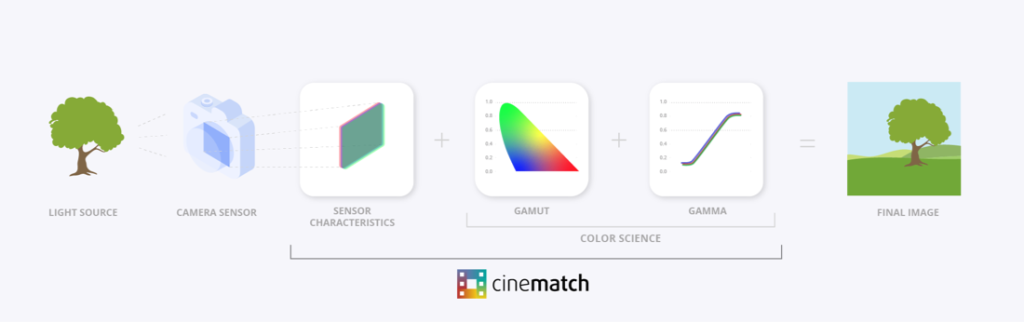
FilmConvert's CineMatch has profiles for over 70 different cameras to reverse engineer the secret sauce that defines how each camera captures its images.
CineMatch can then transpose the differences between one camera’s profile and another, enabling them to match each other accurately.
Save 10% on CineMatch with the discount code “ELWYN” or download the unlimited free trial.