
#505 – Cut/daily Meets... Editor Mollie Goldstein
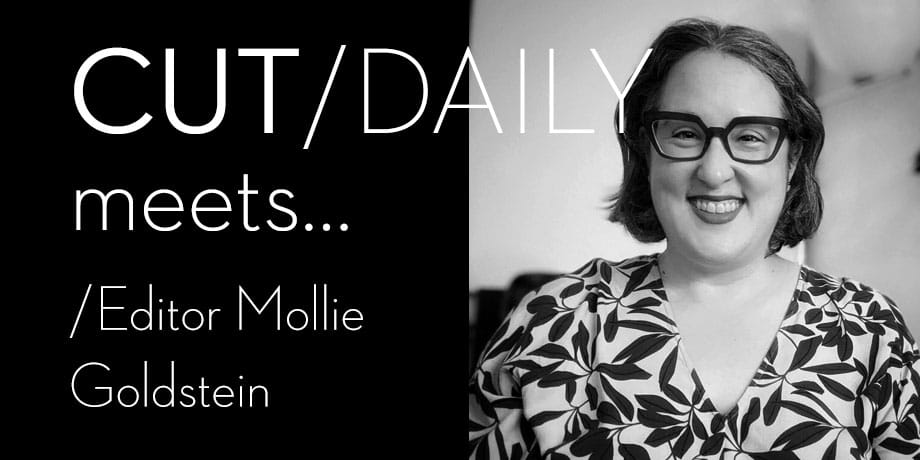
Editor Mollie Goldstein has cut some really interesting projects:
- In the Blink of an Eye
- Hot Water
- Untitled Home Invasion Romance
- Not Okay
- Dickinson (TV series)
- Making The Irishman: A Martin Scorsese Picture
- 24th
- Like Father
- The Art of Getting By
Her two most recent credits are the charming Hot Water (Dir. Ramzi Bashour) and the time-bending In the Blink of an Eye (Dir. Andrew Stanton), which were both at Sundance this year.
If there's one theme that seems to blend through all her projects, to me, it's that you need to keep the funny in the movie, even when it's tackling the reality of life's difficulties.
Which is a good lesson for us all; you may as well laugh.
I love movies that take a swing – that have something to say or are taking a risk somehow. All three of these films are unusual in their tone, original in their approach, or unique in their characterizations.
All three of them felt fresh to me when I read the scripts. And all three directors are kind, collaborative, and love using humor to get their points across (in films and in life).
— Editor Mollie Goldstein
But first...
This Issue of Cut/daily is brought to you in partnership with Louper.io, the best way for video editors like us to run a remote attended edit session. Here's a good reason why...
I'm sure you've experienced this:
- You upload a file for review
- The client drops a comment that it's using the old logo.
- Then you have to chase for the replacement Logo_new.png
- Download the email attachment
- Edit it in
- Re-upload the new version for sign off.
- Edit it in
- Download the email attachment
Not so with Louper!
Now anyone in the session can stream a file live from their browser without first uploading to your Louper storage. And if they have that new logo.png to hand right then and there, any files uploaded in the chat are automatically saved and stored for easy access during or even after the session.
Test drive Louper yourself with free 20 min live streams or start a 10-day free trial to unlock extended 8-hour sessions and store up to 1TB of assets for review.
Even better, signing up with this referral link awards you $50 in credit when you upgrade to any paid plan.
What’s your daily work routine?
It varies wildly based on where I am in the process, but I’m currently in dailies on a film, so that’s what’s fresh in my mind!
So the first thing I do is look over the script notes from the day before, and check off what’s been shot on a massive edit tracker I keep in Google Sheets.
The headings are:

The first set are probably self-explanatory, but I will say that the first and second passes on cutting a scene are distinctly different for me. Pass one is when I put it together to make sure all the pieces are there, pass two is when I make the cut good (or at least professional).
Then I’ll watch everything that has come in that morning; I want to get eyes on the new stuff right away in case I spot a problem right off the bat.
While my AE starts organizing the new set of dailies (I am devoted to Script Sync in Avid and have tortured many assistant editors by requiring it), I’ll cut the footage that came in the day before or do second passes on things that I’ve already assembled.
I like to have a bunch of scenes in different stages so I can move back and forth between them and refresh my eyes when I’m sick of looking at one set of challenges and am ready to trade them for another.
What do you now know about your work that you wish you’d known when you first started?
Bad ideas are the best thing for you – they’re the only thing that leads to good ideas.
I used to censor myself when I thought an approach wasn’t good enough, or spend time going over and over the details of a scene before I knew the big picture. Now I really push myself to start throwing spaghetti against the wall as soon as possible.
Revising is so much easier (and more fun) than building the first cut, so I just try to put together something that is ready to be fixed. This extends to my relationship with directors, too.
I really try to make people feel safe in my cutting room so they can try things or suggest big swings, and I look for collaborators who will roll with me when I do the same.