
#492 – Where is AI taking your career?
I've been thinking a lot lately about where this is all headed.
Where is AI taking our careers?
What's the logical conclusion of how this all plays out?
If you're feeling afraid. Don't worry, I've got good news.
After absorbing a lot of interesting perspectives on technological shifts of the past, present, and future, I'll share my sources and findings so you can enjoy the same intellectual journey in this week's Issue of Cut/daily.
Thankfully, some timeless wisdom from a Hollywood sage will set us up for this thought exercise with an unshakable foundation:
Nobody knows anything.
— William Goldman, Screenwriter
(Which includes Cut/daily, of course.)
But it's important to remember that no one knows how this will actually play out. Not the AI hype-bros, nor the AI-apocalypse crowd.
This Issue is a sequel of sorts to #433 – How to become great in the age of AI, so pause and re-read that for a lay of the mental landscape, before we continue.
Working in an AI Future Today
At the beginning of 2026, Anthropic released a research study based on 81,000 interviews (conducted by Claude), producing the ‘largest-ever’ qualitative study on what people want from AI, what they're concerned about, and where they feel this is all going.
The entire report is an eye-opening read, but here's the paragraph that stood out to me most...
Freelancers are the exposed middle. They benefit from AI while feeling in a precarious situation because of it.
Freelance creatives, in particular, sit at 23% lived benefit and 17% lived precarity—the one group where the upside and downside nearly cancel out.
AI is both their tool and their competitor.
— Anthropic
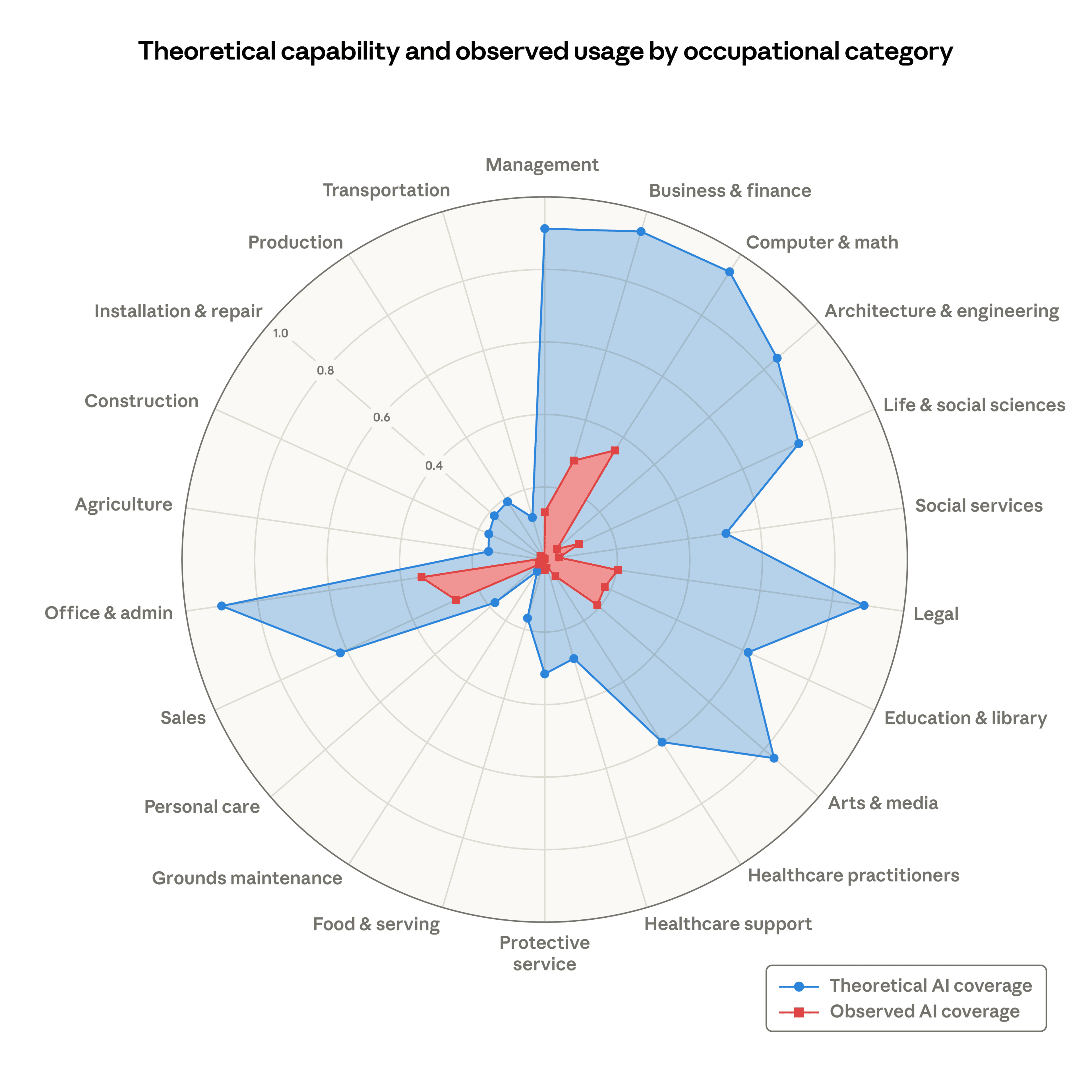
Add to that the image above from Anthropic's ‘Labor Markets impact of AI’ report, where you can see the current gap between the red area, which shows how people currently use Claude, and the blue area, which maps the ‘theoretical capabilities’ of AI's ability to handle tasks in that domain.
The coverage shows AI is far from reaching its theoretical capabilities. For instance, Claude currently covers just 33% of all tasks in the Computer & Math category.
As capabilities advance, adoption spreads, and deployment deepens, the red area will grow to cover the blue.
There is a large uncovered area too; many tasks, of course, remain beyond AI's reach—from physical agricultural work like pruning trees and operating farm machinery to legal tasks like representing clients in court.
Theoretically, 80% of Arts and Media could be automated by AI, apparently.
What does this mean?
It means when you read this kind of data, you start to feel scared.
But you shouldn't.