
#513 – What AI is really taking from you
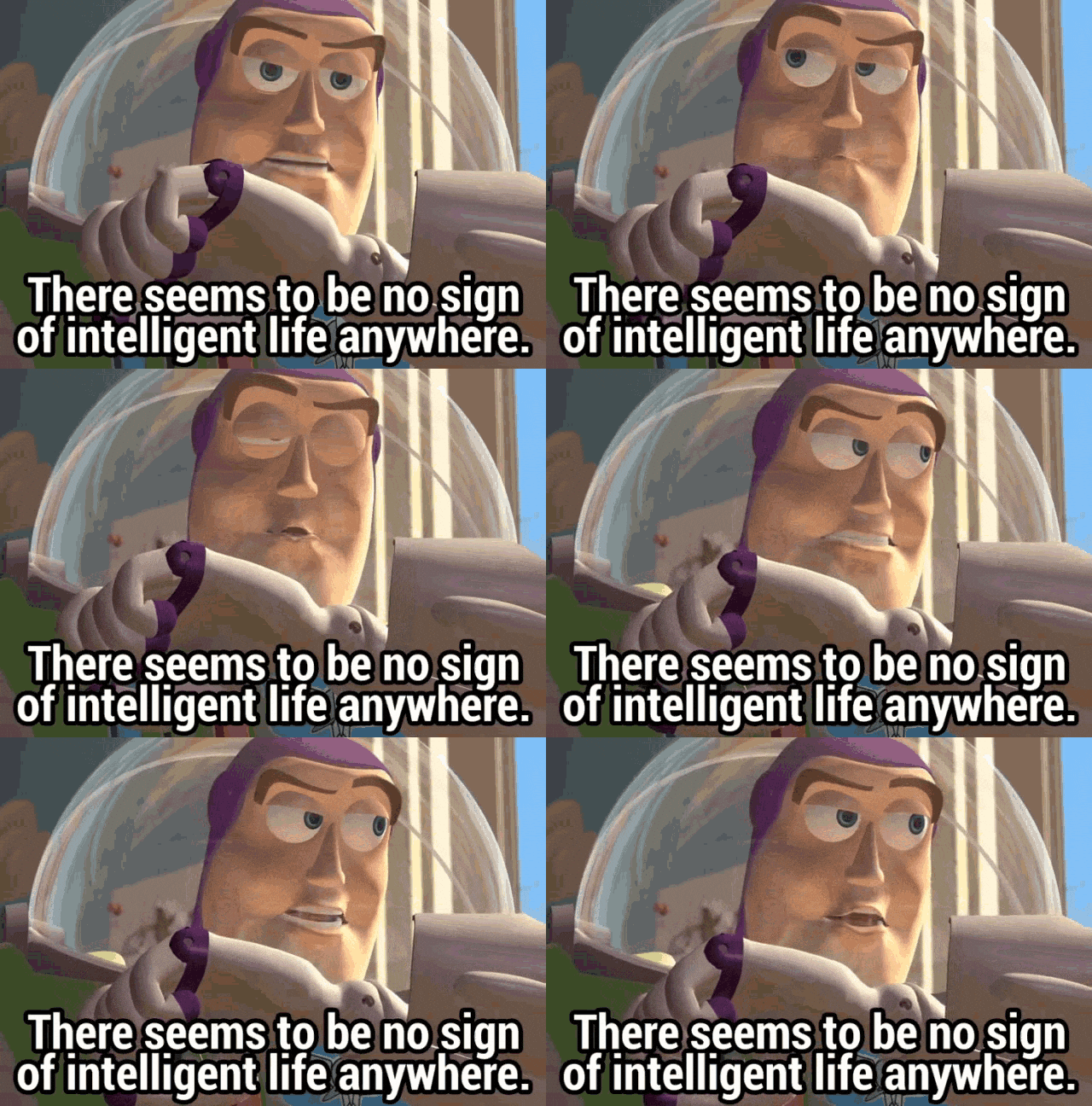
I wasn't planning on writing about AI two weeks in a row, yet here we are and I think this one is important.
While I've mostly been writing about useful ways to put AI to work, how it sometimes doesn't work at all and how to become a great in the age of AI, this week I wanted to share a thought about what we're losing by relying on AI in the first place.
And what we can do about it.
But first...
Look Ma, I can edit!
It turns out I can edit a documentary.
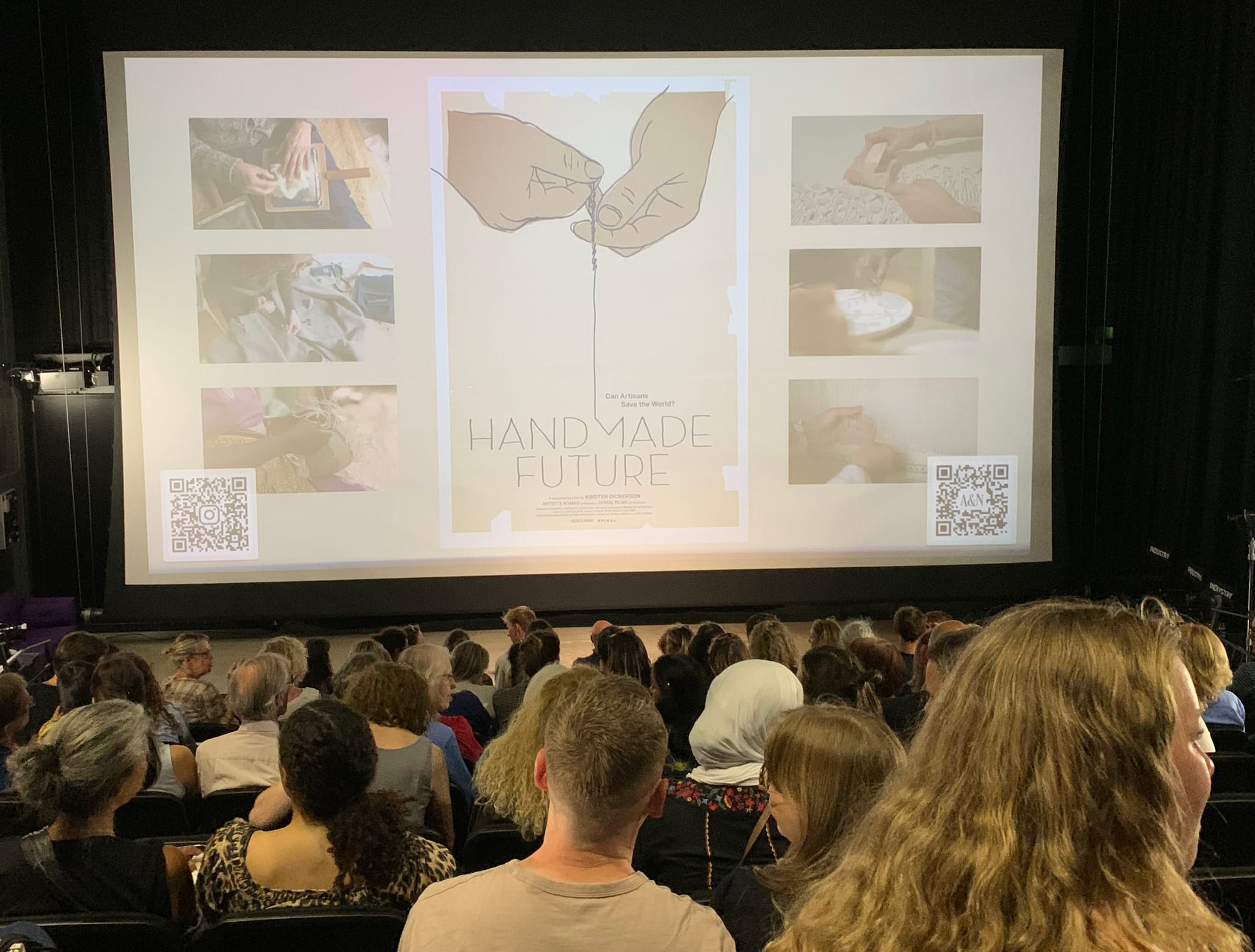
Last weekend I had the unusual (and gratifying) experience of watching something I'd cut with an audience. I highly recommend it.
The documentary I've mentioned a few times on here, (now) titled - Handmade Future, was (surprisingly - to me at least) well received by the audience and I thought most of the film worked really well. There are things I'd change (of course) but hindsight is 20:20 etc. etc.
My wife would tell me off for being characteristically British about all this.
An American (as she is) might say:
“It was awesome! The documentary is really good, the crowd loved it and it's starting to win some awards! Wow, I'm a great editor after all.” — or something to that effect.
Anyway, the main reason to mention all this is that you and your friends can watch the film (and many others) on this excellent indie distribution platform I just discovered called Kinema.
Kinema allows you to host a screening of a film in your local area or through a virtual event, where the profits from ticketing/licensing/rentals are shared between the event organiser and the filmmakers – in our case going into a non-profit grant fund that will be shared by the Artisans featured in the film.
If you've cut something that needs a different way to reach its audience or you just want to find the next big thing that no one else has heard of yet, Kinema could be just what you're looking for.
Now that's a fun way to watch a movie.
This film is a grass roots effort from start to finish. Grass roots funded, grass roots filmmaking and grass roots distribution.
— Kirsten Dickerson, Director
People are worried about stupidity
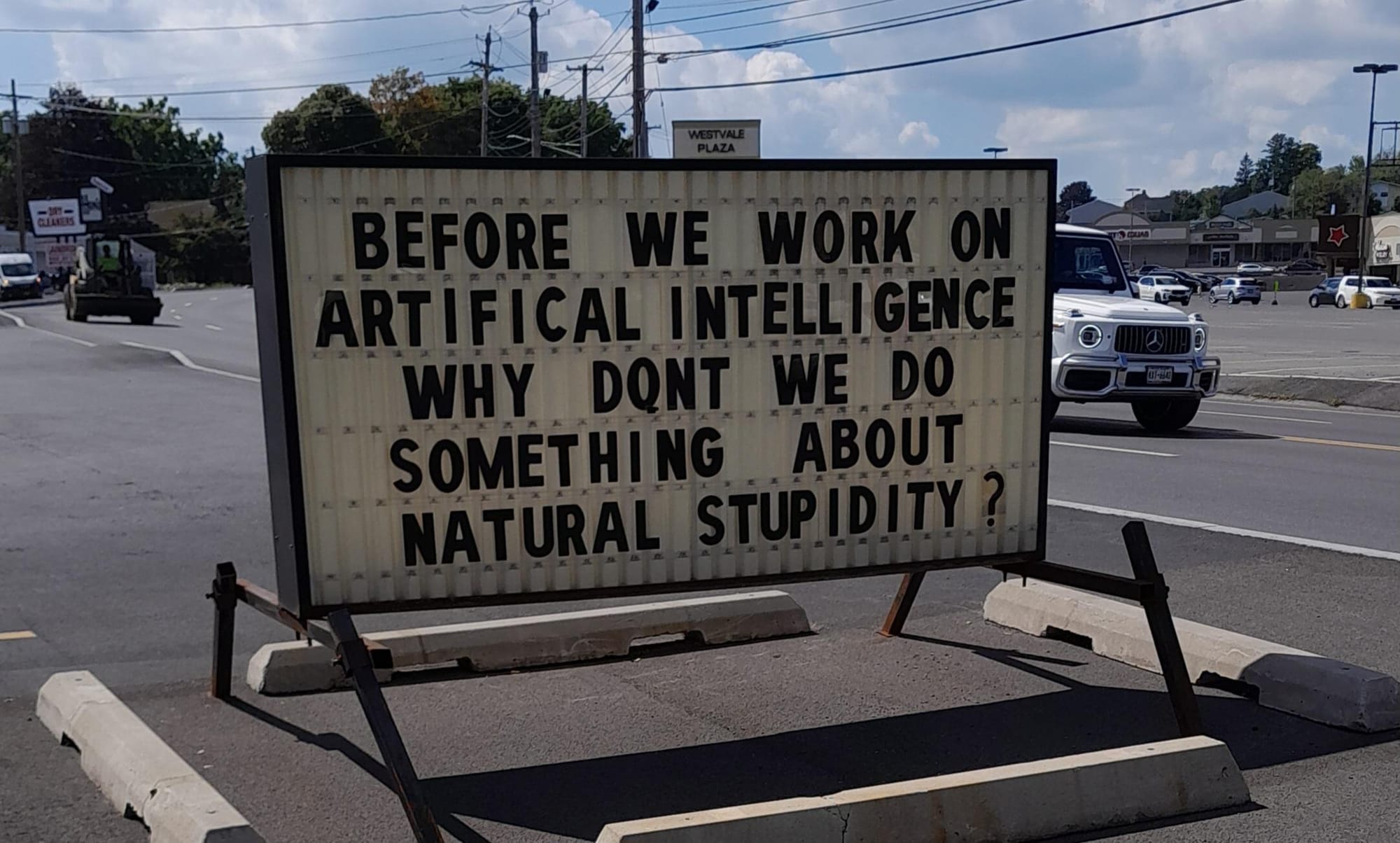
Is AI making us stupid?
Probably.
One group of writers, builders, coders and techpreneurs riding the tidal wave of AI development are the team behind Every.to.
Like a canary in the coal mine, they seem to have noticed what hardcore AI use is doing to their creative intellect.
For example, Kieran Klaassen the solo-developer behind their email-daily briefing app Cora, used to read all his code, checking for bugs, stylistic preferences and other issues. Then he built a clever coding loop that absorbed his preferences and improved all future code as a result.
As the frontier AI model's capabilities grew he realised the code was now good enough that he could just supervise the results and he stopped reading it all together.
But now he's noticed something.
I’m shipping more than I ever have, but I think my brain has gotten softer.
Somewhere along the way, I found that I had lost a feeling. It used to be that learning itself was the reward. But my mind increasingly felt like a TikTok feed—full of short-lived hits of dopamine that left nothing behind.
I started to notice that although the work was improving, I wasn’t. My own mind was the part of the system I had forgotten to measure.
So I built another loop into my system—to fill the gaps in my understanding before they became blind spots in my judgment.
— Kieran Klaassen
Similarly, Every's senior editor, Jack Cheng noticed something important happened when he ran out of AI credits and had to wait to run that task.
The enforced pause gave him time to consider whether the job was even worth doing in the first place. Now, as the most powerful AI models consume less of Jack's tokens, that pause is disappearing with a recognisable effect:
I engage in what software engineering leader Will Larson calls “snacking” — choosing easy, low-impact work over difficult, high-impact work.
When I had to wait, I had more time to notice the difference.
— Jack Cheng
If these guys are noticing it, sooner or later on down the line, we will too.
Slow and stupid wins the race
There are things in life where the value is precisely in the inefficiency, in the time spent, in the pain endured, in the effort you have to invest.
— Rory Sutherland, Pontificator
One of the things you learn after a few miles in the editor's seat, is that if you follow a tried and tested creative process (e.g. assembly > rough cut > fine cut > etc.) it will often lead you to the end result you were hoping for but you do have to “trust the process” along the way, especially when it feels like the process ain't working. (e.g. first assembly...)
One of my favourite thinkers is advertising man Rory Sutherland, who makes an excellent point about the real value of University essays which I think helps apply the brakes on a headlong rush into total AI adoption.
Most of you, if you were students, wrote essays or something like that as undergraduates, right? Fairly confident to say that nobody’s actually kept them? Nobody re-reads them. In fact, the essays you wrote are totally worthless.
But the value wasn’t in the essay. What’s valuable is the effort you had to put in to produce the essay. Now, what AI essays do is they shortcut from the request to the delivery of the finished good and bypass the very part of the journey which is actually valuable—the time and effort you invest in constructing the essay in the first place.
Similarly, the valuable part of advertising is, to some extent, the process of producing it, not the advertising itself. Because it forces you to ask questions about a business which people mostly never get around to asking: What do we stand for? What’s our function? Who do we appeal to? Who’s our target audience? How do we present ourselves? How do we differentiate ourselves? How do we make ourselves look different and feel valuable to the people who encounter us?
One of the reasons I'm not a fan of all these AI-does-the-edit-for-you-tools is that (as I keep saying) some of the “drudgery” they seek to relieve us of, is the very part of the process that helps us do the job.
What should we do about it?
Two researchers at Princeton... Pam Mueller and Daniel Oppenheimer tested 327 students across three experiments, where half took notes on laptops with the internet disabled and half took notes by hand, before testing everyone on what they actually understood from the lectures they had watched.
The handwriting group won by a wide margin on every question that required real understanding rather than surface recall.
The reason was hiding in the transcripts of what the two groups had actually written down.
The laptop students typed almost word for word, capturing more total content but processing almost none of it as they went, while the handwriting students physically could not write fast enough to transcribe a lecture in real time, which forced them to listen carefully, decide what actually mattered, and put it in their own words on the page.
That single act of choosing what to keep was the learning itself, and the keyboard had quietly skipped the choosing and skipped the learning along with it.
— Justin Dechamps, Substack
If there's a lesson to be learned from what the switch from pen and paper to keyboards has done to us, its that it has made us more dumberer.
Writing by hand is not one motion but a sequence of thousands of tiny micro-movements coordinated with your eyes in real time, where each letter is a different shape that requires the brain to solve a slightly different spatial problem.
Your fingers, wrist, vision, and the parts of your brain that track position in space are all working together to produce one letter, then the next, then the next.
Typing throws all of that away.
Every key on a keyboard requires the exact same finger motion regardless of which letter you are pressing, which means the brain has almost nothing to integrate and almost no problem to solve.
– Justin Deschamps
So we should think, then type. But also we should write so we have to think.
As editors we should watch, then write so we have to think too.
If you entrust ‘watching and selecting’ to an algorithm you will “bypass the very part of the journey which is actually valuable.”
Practically speaking:
- We should all be taking notes long hand and exercising our grey matter in the process.
- We should be watching all the rushes ‘long hand’ too.
For me, that means watching through, for example, an interview, chopping responses into chunks and making my own short text annotations* above each one. This slow process helps me absorb and remember key lines, reactions and moments from the footage with far greater efficacy.
*If my handwriting wasn't the kind of scrawl that once got me fired from a temp-job** then maybe I'd do even better if I wrote them out (somehow) with my pen and tablet.
**True fact.
About twenty-five years ago I stopped composing at the keyboard and switched over to fountain pen on paper. Since then I have written many thousands of pages that way.
The manuscript of The Baroque Cycle was a stack of handwritten pages 42 inches high, which for a time was on display at the Museum of Science Fiction in Seattle.
– Neal Stephenson, Author
If you want some tips on choosing a decent pen and paper combo, then author Neal Stephenson is well equipped to deliver those.